

Summary of our key financials
The 2023 budget is demanding due to:
- Increased target resourcing levels to manage the expansion of existing regimes, and the delivery of new regimes
- Emerging inflation risks, underlining the need to benchmark salaries
- Continued investment to enable strategic delivery
An appropriate balance has therefore been struck regarding:
- Our planned 2023 core work streams and the capacity and cost required to deliver them
- Retained liquid asset levels and the potential impact on industry from raising fees to meet higher costs
To achieve this, we will continue to use retained liquid assets from previous years. This aligns with our agreed approach to financial resilience. We have budgeted a £2.2m deficit in 2023 and aim to return to break-even by 2025 based on pre-funding new regimes and reaping the benefits of investment in processes and technology.
Our budget is consistent with our retained liquid assets policy. We will remain well above our minimum threshold and anticipate we will return to our target level by the end of 2025.
|
2022 forecast £'000 |
2023 projected £'000 |
Variance between 2022 forecast and 2023 projected £'000 |
|
| Regulatory fees | 18,336 | 19,513 | 1,177 |
| Registry fees | 7,155 | 6,999 | (156) |
| Other income | 49 | 285 | 236 |
| Total income | 25,540 | 26,798 | 1,258 |
| Staff costs | (16,012) | (20,399) | (4,387) |
| Computer systems | (2,076) | (2,011) | 65 |
| Other operating costs | (5,225) | (5,042) | 183 |
| Total operating expenses | (23,313) | (27,441) | (4,333) |
| Depreciation | (1,543) | (1,540) | (439) |
| Retained profit / (loss) | 684 | (2,139) | (2,928) |
| B/fwd Retained liquid assets | 10,133 | ||
| Operating cash flow | (982) | ||
| Capital investment costs | (1,148) | ||
| C/fwd Retained liquid assets | 8,003 |
Regulatory income
Additional funding is needed in 2023 to resource an enhanced regulatory remit. However, the size of this increase has been lessened by using our retained liquid asset position. We will continue to deploy retained funds to pre-fund new regimes and provide for capital investments, including initiatives to improve operational efficiencies in the medium-term. The resultant increase in fees will be 2% above inflation. This increase will come into effect at separate points during 2023 for each sector because of different regulatory sector fee cycles, with the later fee cycles having less or minimal impact in the 2023 accounting period.
The below figures show forecast fee income from industry sectors compared to 2023 projected fees income:
|
2022 forecast £'000 |
2023 projected £'000 |
Movement £'000 |
Projected fee increase effect date | |
| Banking | 2,176 | 2,389 | 213 | December 2023 |
| Investment Business | 1,668 | 1,901 | 233 | May 2023 |
| Insurance Business* | 1,263 | 1,348 | 85 | October 2023 |
| Funds and Funds Business | 8,310 | 8,738 | 428 | July 2023 |
| Trust Company Business | 4,007 | 4,179 | 172 | January 2024 |
| Other businesses** | 912 | 958 | 46 | Various from June 2023 |
| 18,3336 | 19,513 | 1,177 |
*Insurance Business includes General Insurance Mediation Business
**Other businesses - Designated Non-Financial Businesses and Professions, Money Services Business, and Recognised Auditors
Registry income
Registry income from annual confirmation fees is anticipated to fall by circa £563,000 in 2023 as a direct result of one-off income from additional historical confirmations received in 2022. There is no anticipated increase for Registry fees in 2023, however we will consult on the triennial increase scheduled for 2024.
The table below provides further details on the composition of Registry fee income:
|
2022 forecast £'000 |
2023 projected £'000 |
Variance between 2022 forecast and 2023 projected £'000 |
|
| Annual confirmation fees | 4,040 | 3,645 | (395) |
| Transactional fees | 3,522 | 3,354 | (168) |
| 7,562 | 6,999 | (563) |
Operating costs
Operating costs are planned to increase in 2023 to fund an expanded scope of regulation and to ensure our investment in people, processes, and technology supports regulatory effectiveness.
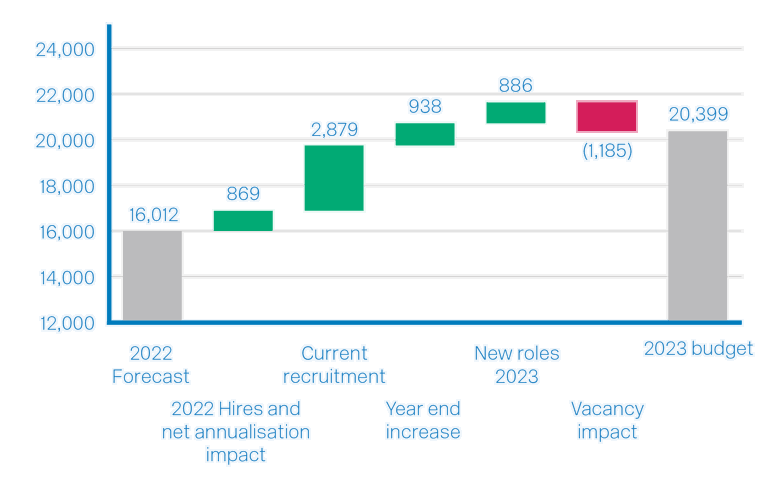
Employee levels are increasing from an average of 204 in 2022 to an anticipated average of 248 in 2023. The average cost per head will rise by 4.6% owing to pay increases associated with rising living costs, but overall, the rise in employee costs is below the rate of inflation due to a changing mix of personnel and associated pay grades.
The employee costs below illustrates the key drivers for the overall cost increase. The Current Recruitment column includes open recruitment roles and those under offer or accepted that have start dates due in 2023:
The operating costs breakdown is shown in the table below:
| Operating expenses |
2022 forecast £'000 |
2023 projected £'000 |
Variance between 2022 forecast and 2023 projected £'000 |
| Staff costs | (16,012) | (20,399) | (4,387) |
| Computer systems | (2,076) | (2,011) | 65 |
| Other operating costs | (5,225) | (5,042) | 183 |
| (23,313) | (27,441) | (4,333) |
Capital investment
Our capital investment programme in 2023 supports the delivery of our strategic core work streams. The majority of costs are linked to investment in technology with continued migration of our core infrastructure to a secure cloud environment. Supplemented by continuous improvements to our core supervisory systems to further enhance operational efficiency and resilience.
|
2022 forecast £'000 |
2023 projected £'000 |
|
| Capital investment costs | 1,360 | 1,148 |