Prescribed Obligations
What is a prescribed NPO?
From 1 January 2023, all NPOs are required to register with us. However, this does not necessarily mean they will be classified as Prescribed NPOs. The definition of a Prescribed NPO can be found in Article 1 of the Non-Profit Organisations (Prescribed NPOs - Additional Obligations) (Jersey) Order 2022 (the Prescribed NPO Order). The Prescribed NPO Order sets out the definition as follows:
"...a prescribed NPO is an NPO that, during the preceding 12 months, has – raised funds exceeding £1,000 from outside Jersey, Guernsey, the Isle of Man, England and Wales and Scotland; or disbursed funds exceeding £1,000 outside those jurisdictions."
If your NPO meets this definition it will be classified as a Prescribed NPO and will be subject to our additional requirements and supervision. The goal of these requirements is to help prevent Jersey's non-profit sector from being abused for terrorist financing purposes.
If you are a Prescribed NPO, and are now considering stopping your activity due to concerns about these additional requirements, get in touch to discuss this further. It is important to us that your good work is not impacted and we would welcome the opportunity to discuss your concerns prior to any action being taken.
Contact our DNFBP / NPO / VASP team
What obligations must a NPO meet?
The additional requirements are detailed within the Prescribed NPO Order, which may already be in place as part of your NPO’s existing good governance.
To assist NPOs with the implementation of the requirements under the Order, we have developed an NPO specific section of the AML/CFT/CPF Handbook (the Handbook). The Handbook provides in-depth, best practice guidance on how an NPO may demonstrate compliance with the requirements of the Prescribed NPO Order. Further information can be located on the Handbook page (section 17) of our website.
Obligations in detail
The below tables summarise the statutory and code of practice requirements for Prescribed NPOs, and guidance for their implementation. They do not represent an exhaustive list of the requirements, but rather sets out the key factors for consideration. Further details can be located within section 17 of the Handbook.
All measures should be appropriate and proportionate to the size and complexity of your NPO. NPOs come in many shapes and sizes, and the requirements and accompanying guidance have been drafted with this in mind.
Article 2 - Obligation to prepare annual financial statement
| Statutory requirement | Article 2 - (1) A prescribed NPO must prepare annually a financial statement for a period of not more than 12 months. (2) The period – (a) must begin on or before the date the NPO became a prescribed NPO; but (b) if the NPO has previously prepared a financial statement under paragraph (1), must begin at the end of the period covered by its most recent financial statement. (3) The financial statement must be in a form published or approved for the purpose by the Commission. (4) A prescribed NPO must provide a financial statement prepared under paragraph (1) to the Commission if required to do so by the Commission. Article 3 - A prescribed NPO must have in place appropriate accounting systems and controls to ensure that its funds are fully accounted for. |
|---|---|
| Code of Practice requirement | Section 17.6 A Prescribed NPO must maintain accounting records that are sufficient to show and explain its transactions. The accounting records must: (1) disclose with reasonable accuracy, at any time, the financial position of the NPO at that time and (2) enable the Prescribed NPO to verify that funds have been received and spent in a manner consistent with the purpose and objectives of the Prescribed NPO |
| Guidance | Section 17.6 A Prescribed NPO may demonstrate compliance with the Code of Practice set out above by regularly reconciling their transactions. The frequency of reconciliation may be determined by reference to the NPO PRA and the NPO’s risk appetite statement (or equivalent documents). Article 2 of the Prescribed NPO Order requires a financial statement to be prepared. However, the level of complexity will depend on the nature and scale of a Prescribed NPO’s operations, as well as their type. For example a small organisation with a relatively simple and low level of activity may consider it sufficient to prepare a statement of income and expenditure. NPOs may be subject to other, at times more stringent, requirements depending on their type. For example, NPOs may be subject to the requirements of the Companies Law. A Prescribed NPO may wish to consider presenting its financial statements for approval by its governing body, e.g. its trustees, board of directors etc. The governing body considers whether the financial statements represent a true and accurate reflection of the Prescribed NPO’s financial position and record their decision on the same. |
Article 4 - Obligation to keep records of owners, controllers etc
| Statutory requirement | (1) A prescribed NPO must keep records that are sufficient to identify – (a) any person who owns the NPO or controls or directs the NPO’s activities, including as appropriate a senior officer, board member, director or trustee; (b) any other person who exercises, or has the right to exercise, significant influence or control over the activities of the NPO. (2) A prescribed NPO must retain the records kept under paragraph (1) for at least 5 years. |
|---|---|
| Code of Practice requirement | Section 17.5.2 Where a Prescribed NPO is a registered Jersey charity, they must maintain a fit and proper person declaration for each charity governor and declare it has done so to the Jersey Charity Commissioner at each annual return to that body. |
| Guidance |
The Handbook contains substantial guidance on the above statutory and code requirements. Key points of note include: |
Article 5 - Obligation to keep record of significant donors
| Statutory requirement | (1) A prescribed NPO must keep a record of significant donors. (2) A “significant donor” means a person who, during the preceding 12 months, donated to the prescribed NPO (as a single donation or cumulatively) – (a) £10,000 or above; or (b) over 50% of total donations made to the prescribed NPO during that period. (3) A prescribed NPO must retain the record kept under paragraph (1) for at least 5 years. |
|---|---|
| Code of Practice requirement | Section 17.7 A Prescribed NPO must keep, for a period of at least five years, records of due diligence (i.e., the identity information) collected for their significant donors. A Prescribed NPO must keep records of transactions undertaken, whether the transactions are done through the formal banking system or using a non-banking platform/method, for a period of at least five years from the date when the transaction was completed. |
| Guidance | Section 17.4.3 Where a significant donor is a natural person, a Prescribed NPO may demonstrate that it has taken reasonable measures to identify that person where it obtains the following information: › Name › Date of birth › Country of birth › Current residential address. Where a significant donor is a legal person (such as a company) or a legal arrangement (such as a trust), a Prescribed NPO should obtain the following information: › date of incorporation or establishment › country of incorporation or establishment › registered address › names of the significant donor’s controllers, e.g. board members or trustees › names of the significant donor’s owners, e.g. shareholders or partners of a partnership arrangement. Information collected on significant Donors may be kept in a register, list, or similar format. Where a significant donor makes regular payments to a Prescribed NPO, it is not necessary to obtain identity information every time a donation is received from that donor. In these cases, Prescribed NPOs should seek to re-confirm the donor’s identity information at least every two years. Where an NPO believes a donor to pose a higher risk it may wish to request additional information from them. |
Article 6 - Obligations in relation to associate NPOs and beneficiaries
| Statutory requirement | (1) A prescribed NPO must take reasonable steps to – (a) identify its associate NPOs and beneficiaries; (b) obtain information about – (i) the activities of each associate NPO and beneficiary, and (ii) the nature and purpose of its relationship with each associate NPO and beneficiary; and (c) confirm, so far as possible, that its associate NPOs and beneficiaries are not assisting or being used to assist terrorism or the financing of terrorism. (2) In this Article – “associate NPO” means an NPO with which the prescribed NPO collaborates or works jointly in carrying out its activities; “beneficiary” means a person who receives assistance through the activities of the prescribed NPO. |
|---|---|
| Code of Practice requirement | Section 17.3.1 A Prescribed NPO must assess and mitigate the risk of being used to assist terrorism, or the financing of terrorism. A Prescribed NPO must define and document their approach to Diversion risk in a risk appetite statement. A Prescribed NPO must have internal systems and controls in place to mitigate Diversion risks. |
| Guidance | NPO Beneficiaries and Associate NPOs Sections 17.4.1 and 17.4.2 NPO Beneficiaries are natural persons or groups of natural persons who receive humanitarian, charitable or other types of assistance through the services of a NPO. Article 6 of the Prescribed NPO Order provides a definition of an associate NPO. Associate NPOs may sometimes be referred to as “Partners” by the NPO sector. NPO Beneficiaries and Associate NPOs can be natural persons, as well as a group of natural persons. Where an NPO Beneficiary or Associate NPO is a single person, a Prescribed NPO may demonstrate that it has taken reasonable measures to identify that person where it obtains the following information: › Name › Date of birth (if possible) › Country of birth › Current area of residence › Principal area of operations (Associate NPOs only) Where an NPO Beneficiary is a group of persons, for example refugees from a particular conflict, there is no requirement to identify each individual person. Where an NPO Beneficiary or Associate NPO is a legal person (such as a company) or a legal arrangement (such as a trust), a Prescribed NPO should obtain the following information: › date of incorporation or establishment › country of incorporation or establishment › principal area of operations › names of the associate NPO Controllers, e.g. Board members or trustees. |
| The amount of identity information requested may differ based on the outcome of the NPO Programme Risk Assessment (or equivalent) - see the section titled Risk based approach below for more information. Identity information for an individual may be obtained directly from the NPO Beneficiary, Associate NPO, or their representative. For an NPO Beneficiary or Associate NPO , a Prescribed NPO may demonstrate that it has taken reasonable measures to confirm that person/persons/organisation is not assisting, or being used to assist, terrorism/the financing of terrorism, where it takes steps to ascertain whether they are a legitimate NPO Beneficiary / Associate NPO. This may include seeking information to confirm they are who they say they are. As part of its reasonable measures in respect of NPO Beneficiaries and Associate NPOs, a Prescribed NPO will need to obtain information on the nature and purpose of their relationship with that person/persons/organisation. It should do this by requesting and documenting the information at the establishment of the relationship. Further details on NPO Beneficiaries and Associate NPOs, and best practice for dealing with them, can be located within Section 17.4 of the Handbook. |
|
| Risk based approach Section 17.3.1 Prescribed NPOs are expected to apply enhanced controls to demonstrate that they are effectively identifying, assessing, managing and mitigating terrorist financing risks. A risk-based approach is not intended to prevent or obstruct aid from reaching legitimate NPO Beneficiaries. It is a way of ensuring it reaches them in the safest way. A risk-based approach can be established through the completion of a NPO programme risk assessment (NPO PRA). The NPO PRA should have regard to all relevant risk factors and should take care not to focus too much on any single factor. Examples of what can be included in a NPO PRA, as well as a template, can be located within Section 17.3.1 of the Handbook. To support the assessment of risks presented by a particular NPO programme of work, it may be appropriate to prepare a risk appetite statement. This statement sets out what level of terrorist financing risk the Prescribed NPO is prepared to tolerate. A clear position, set out in writing, can assist a Prescribed NPO in deciding whether a proposed NPO programme of work creates too much risk exposure to be undertaken. It is our expectation that a risk appetite statement should confirm, at a minimum, that the Prescribed NPO will not tolerate diversion, nor parties that enable diversion. Examples of what can be included in a NPO risk appetite statement are set out within Section 17.3.1 of the Handbook. Ongoing risk monitoring of a NPO programme is a dynamic and cyclical process. It ensures that any new risks are addressed as they arise and establishes how previously identified risks may have changed. See section 17.3.2 of the Handbook for details. |
Risk Appetite Statement
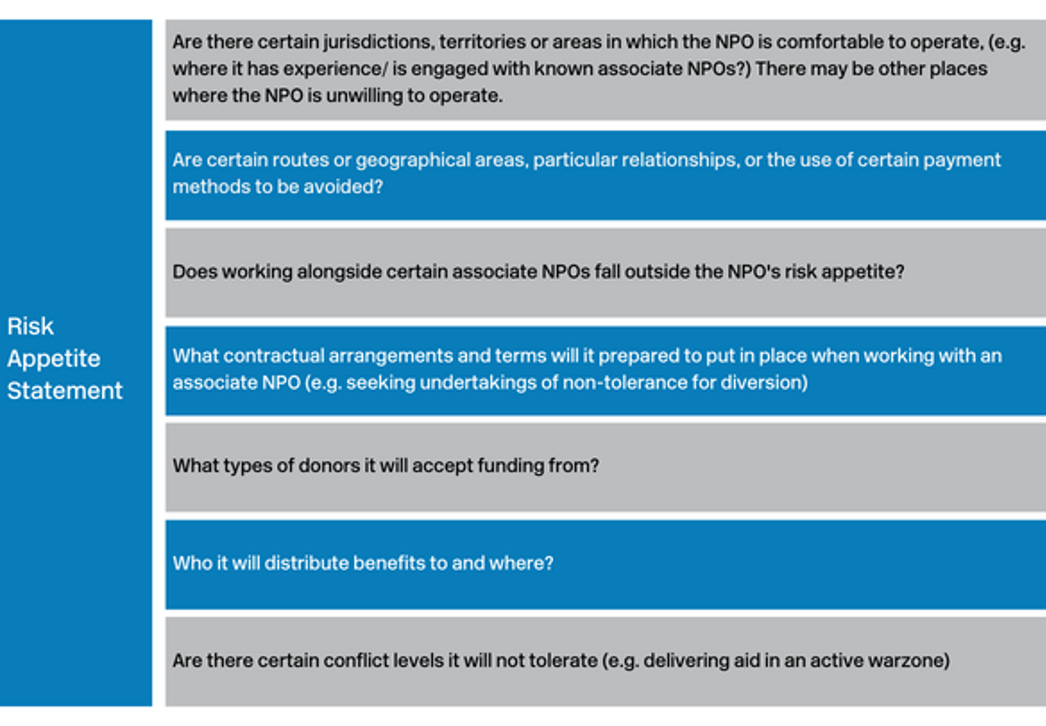
As noted in the above guidance for Article 6, a Risk Appetite Statement is a key document in outlining the level of terrorist financing risk the Prescribed NPO is prepared to tolerate.
This statement can then inform the day-to-day operations of an NPO, with the statement's risk appetite levels consulted when a new programme of work arises to ensure it is in line with the NPO's tolerance. Development of a risk appetite helps to protect the NPO, as well as the sector in Jersey as a whole.
Further guidance and an outline of our expectations regarding the statement can be found within section 17.3.1 of the Handbook: