

Service notice – myProfile and myJFSC will be unavailable due to scheduled maintenance from 3:00pm on Friday 10 April until 8:00am on Saturday 11 April.
2021 Anti-Money Laundering and Counter Financing of Terrorism Training Questionnaire
Background
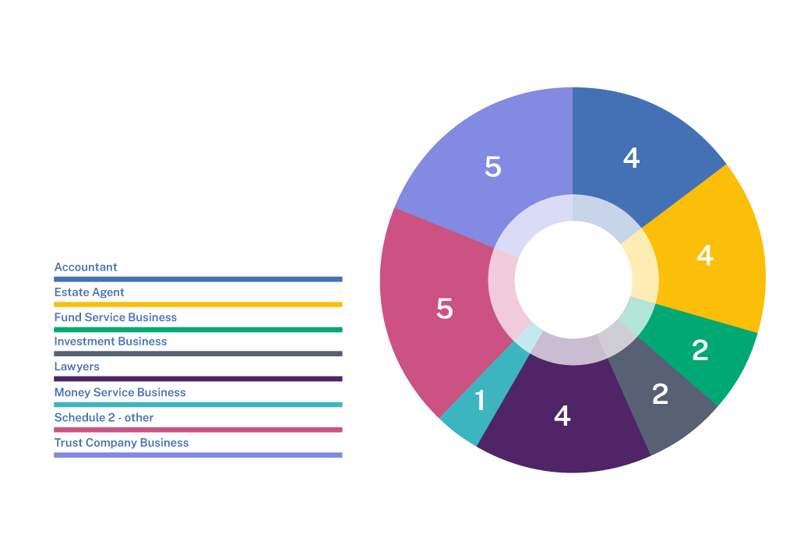
As a result of findings identified through financial crime examinations in relation to employee training, in 2021 we commenced a desk-based thematic examination on the topic, using a questionnaire to gather information from 27 businesses representing a cross-section of Industry sectors.
In October 2021, we asked the 27 businesses to respond to the questionnaire to enable us to understand the methods used by supervised businesses to train relevant and non-relevant employees and to make them aware of the systems and controls (including policies and procedures) that have been established to prevent and detect money laundering and the financing of terrorism.
Each of the 27 businesses selected for the questionnaire was a relevant person as set out in the Money Laundering (Jersey) Order 2008 (the Order). For the purposes of this report, a relevant person is:
- registered with the JFSC under one of the regulatory laws and is referred to as a regulated business; or
- carrying on a business described in Part B of Schedule 2 to the Proceeds of Crime (Jersey) Law 1999 and is referred to as a Schedule 2 business.
The sample of 27 relevant persons included regulated businesses from the following sectors: fund services business (FSB), investment business (IB) and trust company business (TCB). The sample also included the following Schedule 2 businesses: lawyers, estate agents, accountants and lenders. 26 responses were received with 3 respondents confirming they had no relevant employees.
An overview of statutory and regulatory requirements concerning Employee Training
Our thematic work was undertaken with consideration of the statutory and regulatory requirements set out in the Order and the relevant Handbook for the Prevention and Detection of Money Laundering and Countering the Financing of Terrorism (the Handbook) concerning the awareness and training of employees. We have set these out below for your ease of reference.
All relevant persons are required by the Order to ensure that employees whose duties include the provision of financial services (‘relevant employees’):
- are made aware of:
- the CDD, record-keeping, reporting and other policies and procedures for the purposes of preventing and detecting money laundering and the financing of terrorism; and
- the enactments in Jersey relating to money laundering and the financing of terrorism and any relevant Code of Practice; and
- are provided, from time to time, with training in the recognition and handling of:
- transactions carried out by or on behalf of any person who is or appears to be engaged in money laundering or the financing or terrorism; and
- other conduct that indicates that a person is or appears to be engaged in money laundering or the financing of terrorism.
The Order also sets out that training must involve, amongst other things, provision of information on current money laundering techniques, methods and trends.
The relevant Handbook also sets out regulatory requirements in the AML/CFT Codes of Practice for relevant persons in relation to screening, awareness and training of employees.
Money laundering and financing of terrorism offences established in the Proceeds of Crime Law, Terrorism Law and other legislation are wider in scope than those set out in the Order and the AML/CFT Codes of Practice. Consequently, relevant persons are also required to provide information to all employees, to ensure that all of its employees have a basic understanding of money laundering and the financing of terrorism, an awareness of internal reporting procedures and the identity of the MLRO.
The relevant Handbook also provides guidance to relevant persons on how to demonstrate that obligations to promote awareness and train all employees are being met.
Thematic findings
Overall, 24 of the 26 respondents to the questionnaire provided responses that indicated that they would be able to demonstrate that arrangements in place were largely compliant with statutory and regulatory requirements set out above concerning the awareness and training of employees.
Pleasingly 91% of respondents confirmed that they had procedures in place to ensure that employees whose duties relate to the provision of a financial services business received training which addressed all the areas required by the Order.
Two respondents confirmed that they did not have procedures that monitor and test the effectiveness of policies and procedures including the measures established to promote employees’ awareness and the training provided to employees.
The relevant Handbook provides guidance regarding ways in which relevant persons may demonstrate that they are complying with statutory and regulatory requirements concerning screening, awareness and training of employees. Relevant persons may wish to consider their own arrangements in respect of the following information provided by questionnaire respondents, to determine whether enhancements could be made to their own systems and controls to demonstrate higher levels of compliance.
These areas are set out below:
- Four respondents indicated that induction training for new employees was not completed within 10 working days of them commencing employment.
- Three respondents indicated that they did not provide employees with a written explanation of the disciplinary measures that may be applied for failing to report knowledge, suspicion or reasonable grounds for knowledge or suspicion of money laundering or the financing of terrorism without reasonable excuse, or as soon as it is practicable.
- Four respondents highlighted that they did not require employees to acknowledge that they understood written explanations and procedures for making an internal SAR.
- Seven respondents confirmed AML/CFT training had not been delivered to all employees at least once every two years.
- Six respondents confirmed that they did not circulate relevant material to employees e.g. material that is published by us, Jersey Financial Crime Unit, Financial Action Task Force and Moneyval.
- Seven respondents confirmed that they did not circulate relevant media reports concerning money laundering or the financing of terrorism.
Conclusion and next steps
As a result of the findings arising from this questionnaire, follow-on supervisory engagement has taken place with certain relevant persons, where questionnaire responses indicated that the relevant person may not be able to comply with all statutory and regulatory requirements. This will have included formal remediation plans being agreed, or other supervisory action appropriate to the particular circumstances.
Training and its content must be tailored to the relevant person and relevant to the employees to whom it is delivered. As well as providing training to employees, relevant persons must also ensure that they implement policies and procedures to check that the training provided is effective.
Boards and senior management should consider the matters set out above, assess their own approach, then take action, where necessary, to enhance their own systems and controls.
We believe the vigilance and awareness of well-trained employees is a critical element in a fully effective control framework that is designed to prevent, detect and report money laundering and terrorist financing activity. Consequently, we will continue to assess employee awareness of money laundering and terrorist financing risks and the relevance and effectiveness of training provided to employees by relevant persons during examination and other supervisory engagements.
Glossary
|
Board |
Board of Directors, the Board function described in Section 2.1 of the Handbook |
|
Guidance |
Guidance provided to relevant persons in the relevant Handbook |
|
Handbook |
Handbook for the prevention and detection of money laundering and the financing of terrorism |
|
JFSC |
Jersey Financial Services Commission |
|
Order |
Money Laundering (Jersey) Order 2008 |
|
Regulatory laws |
Collectively the: Banking Business (Jersey) Law 1991; Collective Investment Funds (Jersey) Law 1988; Financial Services (Jersey) Law 1998; and Insurance Business (Jersey) Law 1996 |
|
Regulated business |
A person that is registered with, or holds a permit issued by, the JFSC under one of the regulatory laws |
|
Regulatory requirements |
The AML/CFT Codes of Practice contained within the relevant Handbook |
|
Relevant Employee |
Employees whose duties relate to the provision of a financial services business |
|
Relevant person |
Means a person carrying on financial services business in or from within Jersey as defined under Article 1(1) of the Order |
|
SAR |
Suspicious Activity Report |
|
Schedule 2 business |
A business described in Part B of Schedule 2 to the Proceeds of Crime (Jersey) Law 1999. Schedule 2 businesses include accountants, estate agents, the legal profession, dealers in high value goods and other businesses such as those involved in lending. |